
Agentic AI in the Data Center Industry: The Architecture of Autonomous Operations
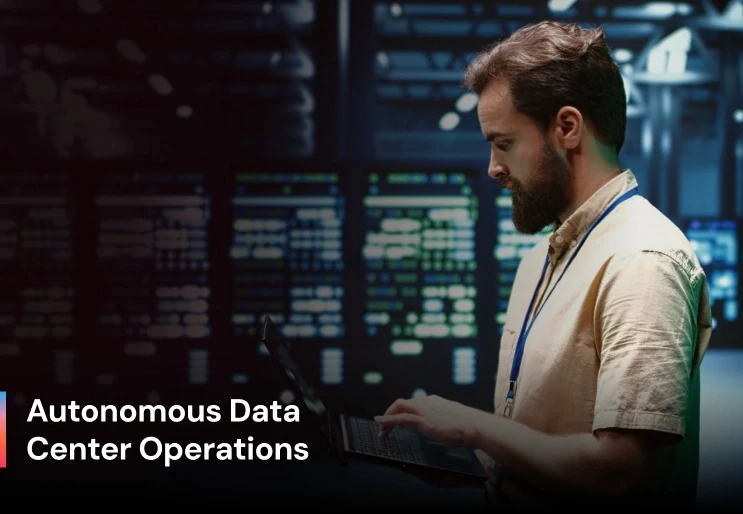
Agentic AI in data centers refers to autonomous AI systems that can perceive infrastructure conditions, reason against defined goals, and take action without human intervention. Unlike traditional automation or AIOps tools that only detect or recommend, agentic AI executes decisions to maintain performance, reliability, cost efficiency, and SLA compliance.
As digital transformation accelerates, data centers have become the backbone of enterprise operations. Growing workloads, dynamic SLAs, hybrid-cloud architectures, and rising energy costs are pushing traditional monitoring and rule-based automation beyond their limits. Enterprises now require autonomous data center management systems that can act in real time to achieve business outcomes.
From Predictive Analytics to Autonomous Data Center Operations
Modern data centers generate massive volumes of telemetry, including:
CPU and memory utilization
Network throughput and latency
Thermal gradients and cooling efficiency
Power consumption and energy pricing signals
AIOps and predictive analytics help teams understand trends and anticipate risk. However, insight alone is insufficient in highly dynamic environments.
The shift is moving from:
“Here’s what might happen”
to:
“Here’s what should happen next—and the system is already doing it.”
Agentic AI closes the loop by combining real-time observability, goal-driven reasoning, and autonomous execution, enabling self-managing data center infrastructure.
Gartner’s View on Agentic AI Adoption
Industry analysts highlight a clear transition toward autonomous AI systems in enterprise IT:
By 2028, nearly 33% of enterprise applications are expected to include agentic AI capable of making autonomous decisions.
Today, only about 15% of IT leaders are actively piloting or deploying fully autonomous AI agents.
Why Adoption Is Still Cautious
The primary challenges are not technical limitations, but:
Governance and accountability
Trust and explainability
Organizational and operational readiness
The Road Ahead
By 2030, more than 80% of enterprises are expected to rely on specialized, domain-specific AI agents for mission-critical objectives. This positions agentic AI as a foundational layer for future data center operations rather than an experimental technology.
Key Capabilities of Agentic AI in Data Centers
1. Autonomous Incident Mitigation
Data centers operate as tightly coupled ecosystems across compute, storage, network, power, and cooling. Agentic AI continuously analyzes live telemetry, models failure scenarios, and initiates preventive actions before incidents escalate.
Instead of merely detecting a potential hardware failure, an agentic system can:
Proactively redistribute workloads
Adjust cooling zones to prevent thermal stress
Schedule maintenance during low-impact windows
This proactive approach reduces unplanned downtime and operational costs.
2. Self-Optimizing Workload Placement
Enterprise workloads must adapt to changing demand, cost constraints, and SLA priorities. Agentic AI continuously evaluates multi-dimensional metrics to decide:
Where workloads should run
When services should scale up or down
Which resources should be released or decommissioned
This enables real-time infrastructure optimization without manual intervention or static policies.
3. Energy and Thermal Optimization
Energy expenses can account for up to 50% of total data center operating costs. Agentic AI dynamically coordinates IT workloads with cooling and power systems using predictive thermal models and load forecasts.
Key benefits include:
Improved power usage effectiveness (PUE)
Alignment with dynamic energy pricing
Reduced carbon footprint and sustainability gains
4. Autonomous Security Incident Response
Traditional SIEM platforms depend heavily on analyst intervention. Agentic AI enhances security operations by enabling autonomous agents to:
Enrich security alerts with contextual intelligence
Assess risk severity in real time
Execute containment or remediation actions within defined guardrails
This significantly reduces mean time to respond (MTTR) and strengthens data center security posture.
Agentic AI vs Traditional Data Center Automation
Metric | Traditional Automation | Agentic AI |
|---|---|---|
Decision Making | Rule-based | Goal-driven reasoning |
Incident Response | Reactive | Proactive and autonomous |
Human Involvement | Continuous | Exception-only |
Energy Optimization | Static thresholds | Continuous optimization |
Infrastructure Utilization | Manual tuning | Real-time autonomous |
Business Impact of Agentic AI in Data Centers
Organizations implementing agentic AI for data center management experience:
Faster incident resolution
Reduced SLA violations
Lower operational and energy costs
Improved infrastructure utilization
Higher reliability and predictability
These outcomes directly support enterprise goals around scalability, cost control, and resilience.
Governance, Trust, and Human Oversight
Successful adoption of agentic AI requires strong governance frameworks, including:
Clear policy boundaries and decision guardrails
Auditability and explainable AI models
Human-in-the-loop approval for high-risk actions
Alignment with regulatory and compliance requirements
Responsible autonomy is critical to building trust in autonomous data center systems.
Conclusion: The Future of Autonomous Data Centers
Agentic AI marks a fundamental evolution in data center management—from insight-driven analytics to fully autonomous operations that can perceive, decide, and act in real time.
For enterprise IT and data center leaders, agentic AI is not just a technical upgrade but a strategic advantage. Organizations that adopt autonomous data center management today will be best positioned to deliver resilient, efficient, and intelligent infrastructure in an increasingly complex digital landscape.